
Kent Grand vs Aquaguard Sure Delight NXT: Which Water Purifier Should You Buy in 2026?
The Problem With Drinking Water in Indian Homes
You fill a glass from the tap, hold it up to the light, and it looks fine. Clear, no smell, no visible particles. So you drink it — and then you spend the next week wondering why your stomach has been off, why your child keeps getting throat infections, or why the water just tastes slightly wrong no matter how cold you make it. You get a TDS meter on Amazon for ₹300 and test your tap water. The reading comes back at 780 ppm. You look it up and find out the safe drinking limit is 500 ppm. The water you have been drinking for years is well above it.
Or maybe you already know your water is bad. You live in a city like Chennai, Bengaluru, or parts of Delhi NCR where borewell water is the primary supply for most apartments. You have seen the white deposits forming on the inside of your kettle after two weeks of use. You have noticed that your hair feels different after washing. You buy 20-litre cans of packaged water every week — spending ₹400 to ₹600 a month on water that should be coming out of your tap in a usable state. The can supplier is unreliable. Sometimes he does not come for three days. You run out. You boil tap water and hope it is enough.
These are not edge cases. They are the daily water reality for tens of millions of Indian households. Boiling water kills bacteria but does nothing about dissolved salts, heavy metals, or the TDS that makes water taste wrong and causes long-term health concerns. A good RO purifier solves all of this — and removes the packaged water dependency entirely.
The two brands that come up in every Indian household's consideration when buying a water purifier are Kent and Aquaguard. They have been competing for the same Indian kitchen wall for twenty years. Both are trusted. Both work. But they are not the same product — and at similar price points, the differences matter more than most comparison pages acknowledge.
How a Good RO Purifier Actually Changes Things
A reverse osmosis purifier forces water through a semi-permeable membrane under pressure. The membrane has pores small enough to block dissolved salts, heavy metals, fluoride, arsenic, nitrates, and most chemical contaminants — while allowing water molecules through. What comes out the other side is water with dramatically reduced TDS, free of the dissolved impurities that boiling cannot touch. Combined with UV sterilisation, which kills bacteria and viruses, and UF filtration, which removes fine sediment, a good RO+UV+UF purifier delivers water that is genuinely safe regardless of what your source water TDS or bacterial load looks like.
The practical change in daily life is immediate. The packaged water cans stop coming. The kettle stops building white deposits. The water tastes clean — not flat the way some cheaper RO systems produce, but genuinely clean. Children stop getting the recurrent stomach issues that parents in high-TDS cities often assume are just part of growing up. Cooking improves too — dal and rice cooked in properly purified water tastes noticeably different from the same recipe made with hard borewell water.
The savings add up faster than most people expect. A household spending ₹500 a month on packaged water recoups the cost of a ₹10,000 purifier in under two years — and a good RO purifier lasts five to eight years with regular filter changes. The two models worth seriously comparing at the under ₹13,000 price point are the Kent Grand RO and the Aquaguard Sure Delight NXT. Here is exactly how they stack up.
Kent Grand vs Aquaguard Sure Delight NXT — Which Water Purifier Should You Pick in 2026?
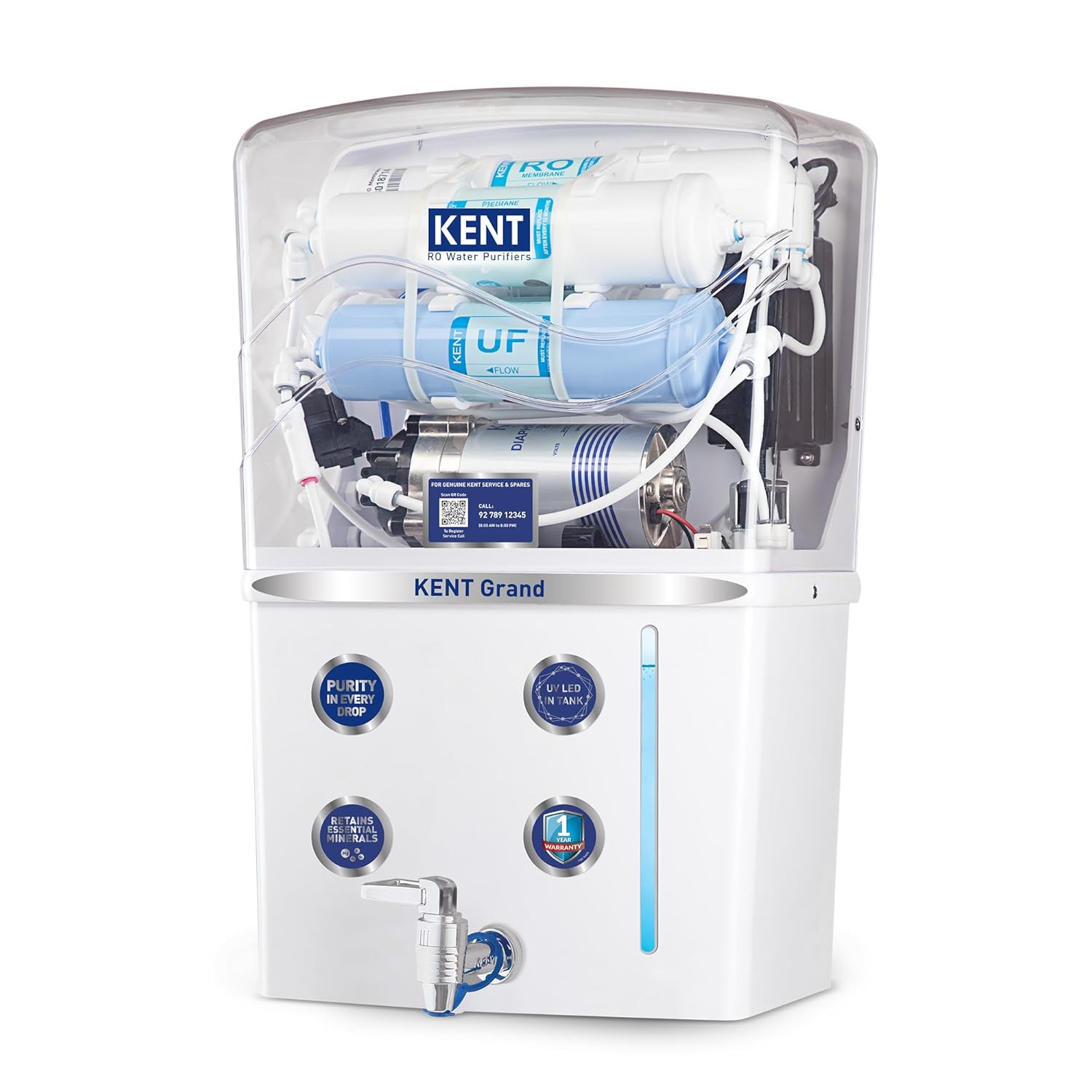
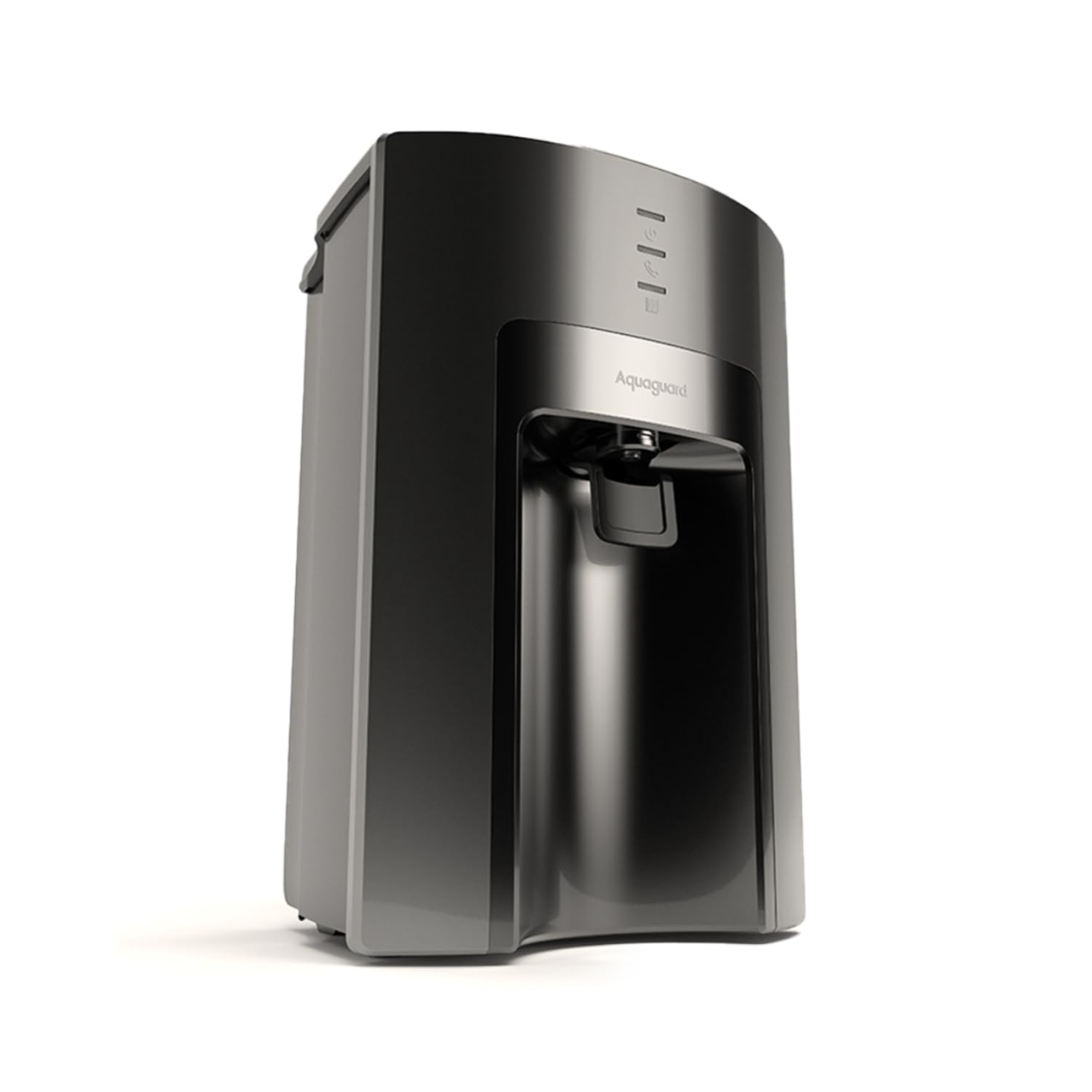
| Spec | Kent Grand RO | Aquaguard Sure Delight NXT |
|---|---|---|
| Price | ₹12,598 | ₹9,499 |
| Purification | RO + UF + UV LED + TDS Control | RO + UV |
| Storage | 8 Litres | 6 Litres |
| Flow Rate | 20 LPH | 3 L/min |
| Max TDS | 2000 ppm | 2000 ppm |
| UV LED Tank | Yes | No |
| TDS Controller | Yes | No |
| Installation | Wall Mount / Freestanding | Countertop |
| Filter Life | — | 1 Year |
| Free Service Plan | No | Worth ₹2,000 |
| Amazon Rating | 4.4 ★ (7,150 reviews) | 4.2 ★ (3,091 reviews) |
| Service Network | Largest RO-specific network in India | Widest pan-India coverage |
Kent Grand vs Aquaguard Sure Delight NXT: Head-to-Head Comparison
1. Purification Technology — Where Kent Pulls Ahead
Both purifiers use RO as their primary stage — the membrane filtration that actually reduces TDS and removes dissolved heavy metals, salts, and chemical contaminants. Both support water with TDS up to 2000 ppm, which covers even the most challenging borewell and tanker water conditions found in Indian cities. On the fundamental purification question — will it make my water safe to drink — both deliver the right answer.
Where the Kent Grand separates itself is in two specific additions. The first is the UV LED tank. Standard RO purifiers, including the Aquaguard Sure Delight NXT, use UV sterilisation only during the active purification process — water passing through the UV chamber gets treated, but once it sits in the storage tank, there is no ongoing protection. In Indian conditions where ambient temperatures are high and water can sit in the tank for hours or overnight, bacterial recontamination in the tank is a real concern. The Kent Grand's UV LED continuously sterilises water inside the storage tank, which means even water that has been sitting for eight hours is still actively protected at the moment you pour it.
The second is the TDS controller. Standard RO removes virtually all dissolved minerals along with contaminants — which is thorough but produces water that tastes flat and strips out beneficial minerals like calcium and magnesium. The Kent Grand's TDS controller allows a calibrated portion of filtered water to bypass the RO membrane and blend back in after purification, retaining a controlled level of essential minerals. The result is water that is both safe and tastes natural — closer to what good mineral water tastes like rather than the empty taste of heavily demineralised RO output.
UV LED tank protection and TDS controller are genuinely meaningful upgrades that the Aquaguard does not offer at this price point.
2. Storage and Flow Rate
The Kent Grand has an 8-litre storage tank versus the Aquaguard's 6 litres. For a family of 3 to 4 people, the difference matters most during peak usage times — morning routines when everyone needs water for drinking, cooking, and making chai simultaneously. An 8-litre tank handles this more comfortably without running low mid-peak. For a couple or a family of two, the Aquaguard's 6 litres is entirely adequate for daily needs.
The Aquaguard counters with a flow rate of 3 litres per minute — which is actually faster for immediate dispensing than the Kent's 20 LPH rated throughput. In practical terms this means filling a 1-litre bottle takes about 20 seconds from the Aquaguard versus a slightly longer wait from the Kent at equivalent demand. The Aquaguard's countertop installation also makes it easier to relocate if you move or rearrange your kitchen — the Kent's wall or freestanding mount is more permanent.
Larger tank handles family usage more comfortably, though Aquaguard's faster flow rate and countertop flexibility are genuine advantages for smaller households.
3. Features and Daily Usability
The Kent Grand's UV LED tank and TDS controller have already been covered under purification. On the usability side, Kent's filter replacement alert system notifies you before the filter reaches end of life — a practical feature that ensures you never unknowingly consume water through a degraded filter. The wall or freestanding installation keeps your counter clear, which matters in compact Indian kitchens where counter space is limited.
The Aquaguard Sure Delight NXT keeps things simple — LED indicators show purification status and signal when filter replacement is due. The countertop form factor means zero wall drilling and easy placement anywhere near a water connection. The free service plan worth ₹2,000 included with the Aquaguard is a meaningful practical benefit — it covers the first professional maintenance visit, which you would otherwise pay for separately within the first year of ownership. For first-time RO buyers who are not sure about the maintenance process, having the first service covered removes a significant uncertainty.
More features overall — but Aquaguard's included ₹2,000 service plan and simpler countertop installation are genuinely useful for first-time buyers.
4. After-Sales Service — The Most Underrated Factor
This is where the comparison gets genuinely close. Both Kent and Aquaguard have strong service networks — but they are strong in different ways. Kent has built the largest dedicated RO purifier service network in India, with technicians specifically trained on RO membrane replacement, TDS controller calibration, and UV lamp servicing. In most tier-1 and tier-2 cities, Kent service is available within 24 to 48 hours and replacement parts are consistently in stock.
Aquaguard by Eureka Forbes has the broadest geographical service coverage in India — they reach tier-2, tier-3, and even smaller towns where Kent's specialised RO network may not have a presence. If you live outside a major metro, Aquaguard's wider footprint is a meaningful advantage. Eureka Forbes also pioneered the direct-to-home service model in India and their technicians are trained on the full Aquaguard range. The free ₹2,000 service plan included with the Sure Delight NXT means your first service call is already paid for.
Kent wins in metros and large cities for RO-specific expertise. Aquaguard wins in smaller cities and towns for broader geographical reach.
5. Price and Value
The price gap here is more significant than in the air fryer comparison — ₹12,598 for the Kent Grand versus ₹9,499 for the Aquaguard Sure Delight NXT. That is a ₹3,099 difference, which is meaningful at this budget level. The question is whether the Kent's additional features — UV LED tank, TDS controller, larger storage, and higher Amazon rating — justify spending 33% more than the Aquaguard.
If your household has high daily water consumption, you live in an area with very high TDS borewell water, or you want the most technically complete purification available under ₹13,000 — the Kent Grand's premium is justified. The UV LED tank protection alone is a feature that directly addresses a real gap in standard RO purification. For a family of 4 or more using purified water for cooking and drinking throughout the day, the better technology and larger tank make the ₹3,099 premium worth paying.
If your water TDS is moderate, your household is smaller, you are buying your first RO purifier and want a trusted name with the lowest friction entry point, or your budget genuinely stops at ₹10,000 — the Aquaguard Sure Delight NXT is not a compromise. It is a strong product from India's most recognised water purification brand, with 3,091 Amazon reviews at 4.2 stars and a free service plan included. It solves the core problem completely.
Kent Grand justifies its premium for larger families and high-TDS water. Aquaguard Sure Delight NXT is the smarter buy if budget is a constraint or household size is smaller.
Final Verdict — Which One Should You Buy?
You have a family of 4 or more, your water TDS is above 500 ppm, you want UV LED tank protection for stored water, and you want mineral-balanced output from the TDS controller. The most technically complete water purifier at this price point and worth every rupee of the premium for the right household.
Your budget is under ₹10,000, your household is 2 to 3 people, you are buying your first RO purifier and want a trusted brand with strong service coverage, or you live outside a major metro where Aquaguard's wider service network is a practical advantage. The included ₹2,000 service plan makes the value proposition even stronger.
For most Indian families, the Kent Grand is the better long-term investment — the UV LED tank, TDS controller, and larger storage address real gaps that the Aquaguard does not. But the Aquaguard Sure Delight NXT is far from a second-best choice — at ₹9,499 with Amazon's Choice status, 3,091 verified reviews, and Eureka Forbes' unmatched service network, it is one of the most reliable water purifiers available in India at this price. If our detailed breakdown of both these models alongside three other top options is useful, you can find the full comparison in our guide to the best water purifiers under 10000 in India 2026.
Frequently Asked Questions
Is Kent better than Aquaguard?
For pure purification technology, Kent has the edge — the UV LED tank in the Kent Grand is a feature Aquaguard does not match at this price point, and Kent's TDS controller produces better-tasting water than standard RO output. For service reach and first-time buyer convenience, Aquaguard is stronger — broader geographical coverage, simpler installation, and the included ₹2,000 service plan. The better brand depends on what your household specifically needs rather than one being categorically superior to the other.
Which water purifier is best for borewell water in India?
For borewell water with high TDS — typically 500 to 1500 ppm in most Indian cities — an RO purifier is non-negotiable. Both the Kent Grand and Aquaguard Sure Delight NXT support up to 2000 ppm TDS which covers all but the most extreme borewell water conditions. The Kent Grand is the stronger choice for very high TDS borewell water because the TDS controller allows mineral retention without compromising purification, and the UV LED tank provides ongoing sterilisation of stored water which matters more when source water bacterial load is higher.
How often do water purifier filters need to be replaced?
Most RO purifier filters need replacement every 6 to 12 months depending on your water quality and daily usage volume. The Aquaguard Sure Delight NXT has a rated filter life of 1 year. Higher TDS source water and larger family usage will reduce filter life closer to 6 months. Annual maintenance cost for both Kent and Aquaguard typically runs ₹2,000 to ₹4,000 per year depending on which filters need replacement. Factor this into the total cost of ownership when comparing the upfront price difference between the two models.
Does RO water remove essential minerals?
Yes — standard RO membranes remove virtually all dissolved substances including beneficial minerals like calcium and magnesium along with harmful contaminants. This is why the Kent Grand's TDS controller is a meaningful feature — it blends a controlled proportion of pre-filtered water back after the RO stage to restore a natural mineral balance. The Aquaguard Sure Delight NXT does not have this feature, meaning its output is more thoroughly demineralised. For families where mineral intake from drinking water is a health consideration, the Kent Grand's TDS controller addresses this directly.
Is it safe to drink RO water every day?
Yes — RO water is safe for daily consumption. The concern about mineral loss is real but overstated for most people — the majority of calcium and magnesium intake in an Indian diet comes from food rather than water. For households where the diet is already mineral-rich through dal, vegetables, and dairy, drinking RO water daily poses no meaningful nutritional risk. The health benefits of removing heavy metals, dissolved salts, and bacterial contamination from drinking water significantly outweigh the mineral reduction that RO produces.
Also Read: Best Water Purifiers Under 10000 in India 2026 | Best AC Under 30000 in India 2026 | Best Chimney for Kitchen Under 10000 in India 2026