
Philips Air Fryer vs Milton Rapid Digital Air Fryer: Which One Should You Buy in 2026?
The Problem With How We Cook Every Day
You come home after a long day. The last thing you want to do is stand over a hot stove for forty minutes, deal with oil splattered across the counter, and then spend another fifteen minutes cleaning up. But the samosas are already in the fridge from yesterday, the kids want something crispy for dinner, and ordering in again feels like giving up. So you heat up a kadhai, pour in the oil, and do it anyway — tired, sweating, and knowing the kitchen is going to smell like fry oil until tomorrow morning.
Or maybe it is Sunday and you are trying to eat healthier. You have read enough about how much oil goes into the average Indian meal — the pakoras, the aloo tikki, the paneer tikka that needs a proper char on the outside. You want to cook it at home, the way it should taste, without drowning everything in oil. But the alternatives — grilling on a tawa, baking in an OTG that takes twenty minutes to preheat — never quite give you that crispy outside that makes the food worth eating in the first place.
And there is the electricity bill concern too. Running a conventional oven for an hour uses significantly more power than most people realise. For households already watching their monthly bills carefully, adding heavy cooking appliance usage on top of the AC and refrigerator feels like it adds up quickly.
These are not unusual problems. They are the daily reality of cooking in an Indian home — whether you are a working professional trying to put dinner together in under thirty minutes, a parent trying to make school snacks that are at least slightly healthier than the packaged alternative, or someone who loves food and just wants to cook more without the cleanup and the oil and the heat.
How an Air Fryer Actually Solves This
An air fryer does one thing very well: it circulates extremely hot air at high speed around your food in a compact, insulated chamber. The result is a crispy, browned exterior that is almost indistinguishable from deep-fried food — without submerging anything in oil. A light spray or brush of oil on the surface is all most recipes need. For frozen snacks or foods that already contain fat, like chicken or paneer, you often need no additional oil at all.
For Indian cooking specifically, this matters more than most product marketing acknowledges. Samosas, pakoras, aloo tikki, tandoori chicken, fish fry, bread rolls, spring rolls — every crispy snack that normally requires a full kadhai of hot oil can be made in an air fryer in less time, with less mess, and with dramatically less fat. The outside gets crispy. The inside stays moist. The kitchen does not smell like a dhaba for the next six hours.
The time saving is real too. Most air fryers reach cooking temperature in under three minutes — compared to a conventional oven's fifteen to twenty minute preheat. A batch of french fries that takes twenty-five minutes of monitoring in a kadhai takes twelve to fifteen minutes in an air fryer with zero oil monitoring required. You set the temperature, set the timer, and walk away. The auto shut-off means nothing burns even if you forget.
The cleanup takes thirty seconds. The basket is non-stick. There is no oil to dispose of, no splatter on the backsplash, no greasy cooktop to scrub. For anyone who cooks regularly in a small Indian kitchen, this alone is worth the price of the appliance within a month.
The two air fryers worth seriously considering at the under ₹5,000 price point right now are the Philips NA120/00 and the Milton Rapid Digital 5L. They are priced within ₹200 of each other but are meaningfully different products. Here is exactly how they compare.
Philips NA120 vs Milton Rapid 5L — Which Air Fryer Should You Pick in 2026?
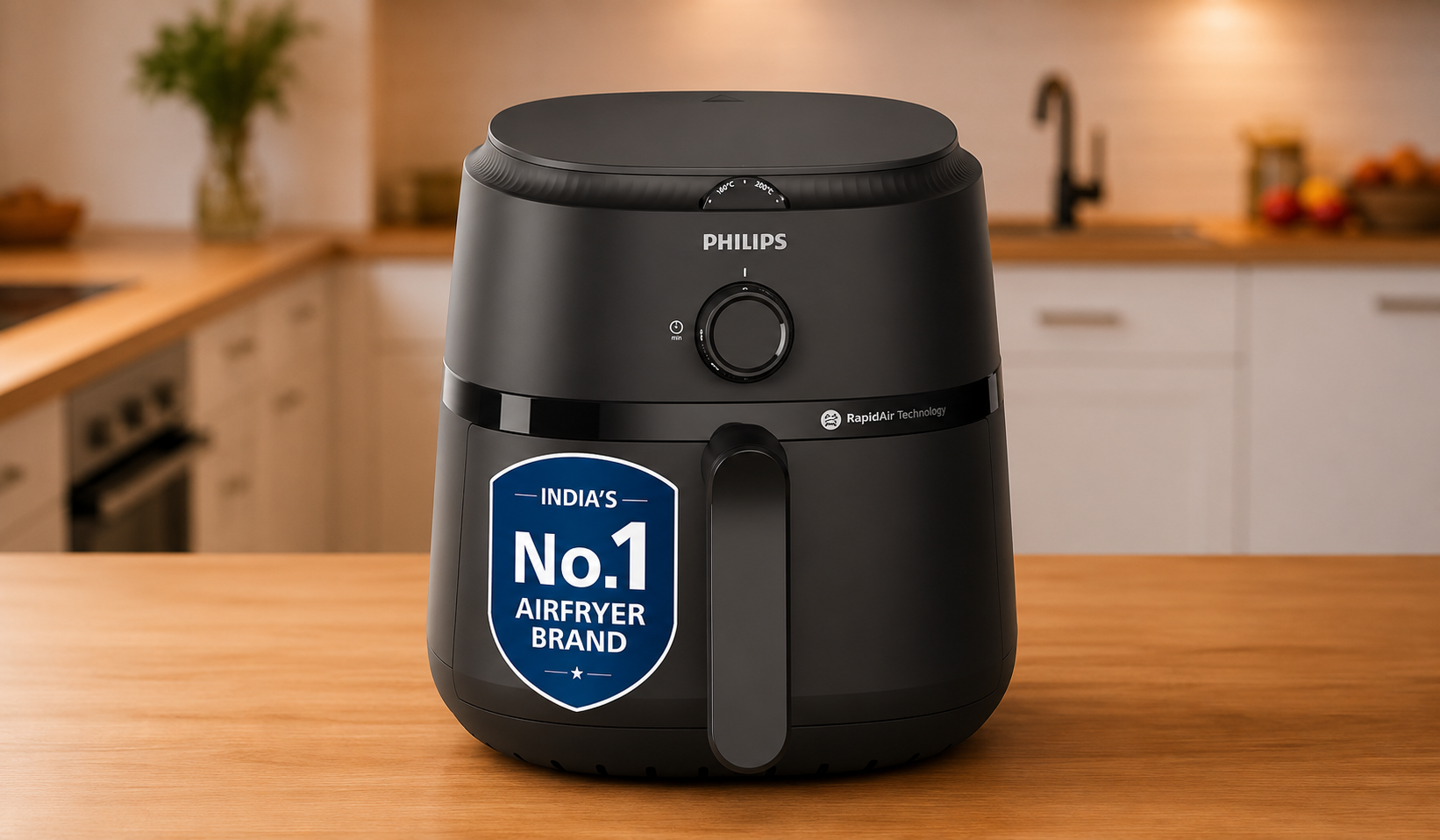
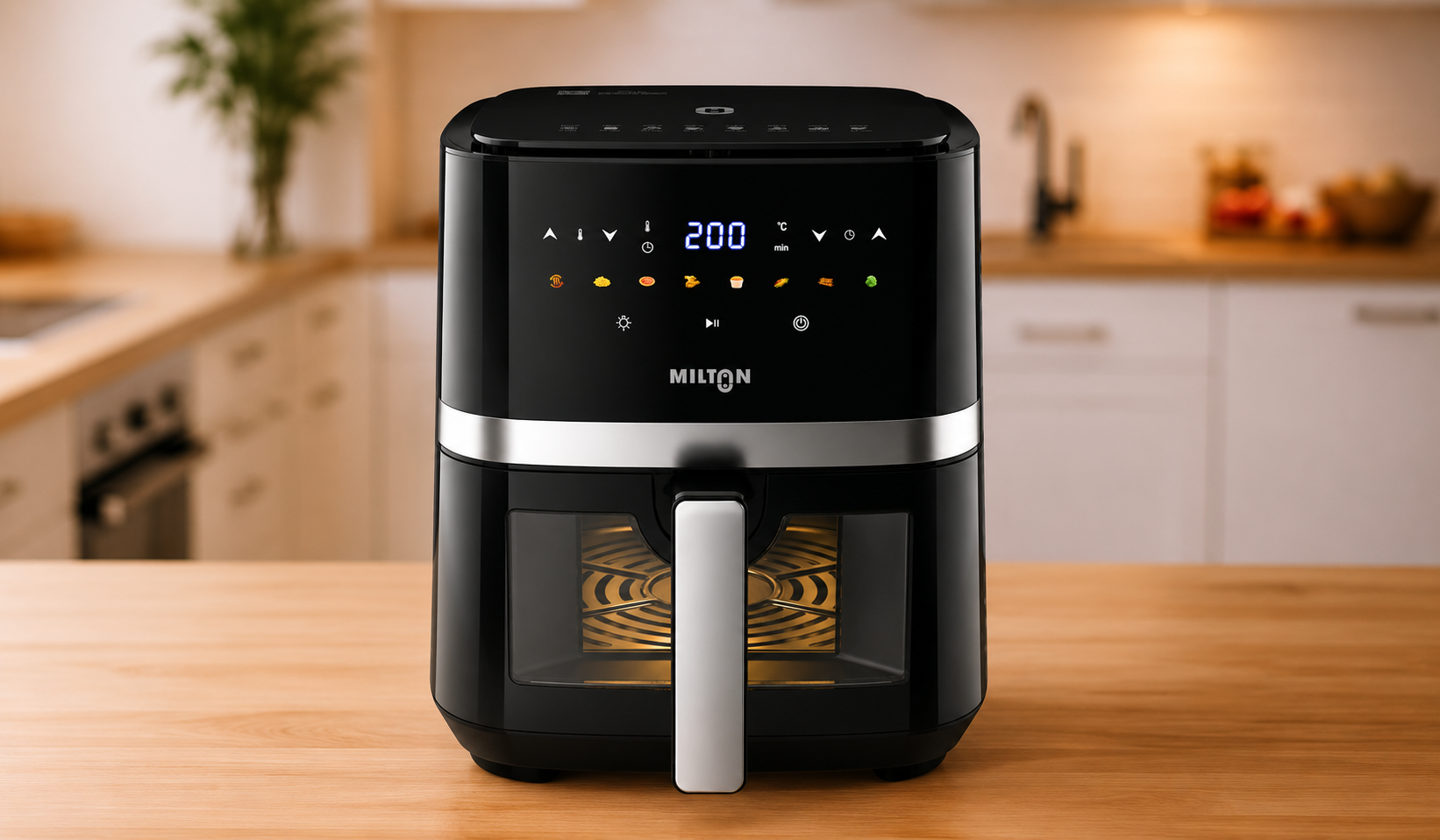
| Spec | Philips NA120/00 | Milton Rapid 5L |
|---|---|---|
| Price | ₹4,699 | ₹4,499 |
| Capacity | 4.2 Litres | 5 Litres |
| Wattage | 1500W | 1450W |
| Temperature Range | 80°C – 200°C | 80°C – 200°C |
| Controls | Touch Panel | Touch Panel + Digital Display |
| Preset Menus | 12 | 8 |
| Air Technology | Patented Rapid Air (Starfish Pan) | 360° High Speed Circulation |
| Auto Shut-Off | Yes | Yes |
| App Support | HomeID App (100+ recipes) | No |
| Warranty | 2 Years | 1 Year |
Philips Air Fryer NA120/00 vs Milton Rapid Digital Air Fryer - Head-to-Head Comparison
1. Capacity — Who Is It Right For?
The Milton wins on raw capacity — 5 litres vs the Philips' 4.2 litres. That 0.8-litre difference is meaningful in practice. A 4.2-litre basket comfortably handles a meal for 2 to 3 people — a batch of fries, a few chicken pieces, or a tray of snacks for the evening. A 5-litre basket handles a family of 4 more comfortably in a single batch, which matters if you are cooking for children and do not want to run two separate batches for the same meal.
For a single person or couple, the Philips 4.2L is more than adequate and the smaller footprint takes up less counter space. For a family of 3 or more, the Milton's extra litre is genuinely useful — particularly for Indian cooking where portion sizes for snacks and sides tend to be generous.
Larger capacity at a lower price — the better choice for families of 3 or more.
2. Cooking Performance — Rapid Air vs 360° Circulation
This is where the Philips earns its premium reputation. Philips invented the air fryer and holds the patent on Rapid Air Technology — the unique starfish-design pan that creates a specific airflow pattern inside the cooking chamber. The starfish ridges on the bottom of the basket force hot air to circulate in a vortex pattern rather than a simple top-down flow, which means more consistent heat contact with every surface of the food simultaneously. The result is more even browning with less need to shake or flip mid-cook.
The Milton uses 360° high-speed air circulation — a strong convection fan that pushes hot air around the food from all directions. This is the standard approach used by most air fryers in this price range and it works well, but it does not match the directional precision of Philips' patented starfish design. In practice, Milton users will find they need to shake the basket or flip food halfway through cooking more consistently than Philips users to achieve even results.
Philips also runs at 1500W vs Milton's 1450W — a small difference on paper, but the combination of higher wattage and more efficient airflow design means the Philips reaches and maintains cooking temperature more consistently, which directly affects crispiness and cooking time. The Philips also has 12 preset cooking programs vs Milton's 8, and connects to the HomeID app which gives access to 100+ recipes calibrated specifically for the NA120's cooking chamber.
Patented Rapid Air technology delivers more even results with less manual intervention during cooking.
3. Features and Controls
Both use touch control panels and both have auto shut-off. The Milton adds a digital display that shows temperature and timer readings more clearly than the Philips' touch interface, which is a genuine usability advantage — particularly for first-time air fryer users who want to see exactly what temperature they are cooking at without guessing. The Milton's 8 presets cover the most common cooking functions: fries, chicken, fish, steak, shrimp, bake, pizza, and reheat.
The Philips counters with 12 presets that cover a wider range of cooking functions including dehydrating — useful for making dried fruits, jerky, or dehydrated snacks at home. The HomeID app integration is a meaningful addition if you are the kind of cook who likes guided recipes — it gives you step-by-step cooking guidance with time and temperature settings pre-configured for the NA120's specific chamber size. For someone new to air frying, this removes a lot of the trial and error that comes with learning a new appliance.
More presets, app recipe support, and dehydration function make it more versatile for everyday Indian cooking.
4. Design and Build Quality
Philips has been making kitchen appliances for the Indian market for decades and their build quality at this price point is consistent and well-documented across 7,565 Amazon reviews. The NA120 uses a compact canopy design that fits under most kitchen cabinets comfortably. The non-stick basket is sturdy and easy to remove. The overall build feels considered rather than cost-cut.
Milton is better known in India for water bottles, lunch boxes, and kitchen storage — their appliance range is newer and less battle-tested than Philips. The Rapid 5L is made from high-quality heat-resistant materials and the build feels solid, but with only 1,516 Amazon reviews versus Philips' 7,565, there is significantly less long-term reliability data available. The larger 5L chassis also means a bigger counter footprint — worth measuring your counter space before buying.
Better validated build quality, more compact design, and a brand with a longer track record in kitchen appliances.
5. Price and Value
The price difference is just ₹200 — ₹4,699 for the Philips vs ₹4,499 for the Milton. At that margin, price alone should not drive the decision. What matters is what you get for that ₹200. The Philips gives you patented cooking technology, a stronger brand legacy, 12 presets, app support, a 2-year warranty, and 7,565 verified reviews at 4.4 stars. The Milton gives you a larger 5L capacity, a clearer digital display, and 8 presets at 4.1 stars across 1,516 reviews with a 1-year warranty.
The Philips' 2-year warranty vs Milton's 1-year is a meaningful difference at this price point — if something goes wrong in year two, the Philips is covered and the Milton is not. For a kitchen appliance used daily, that extra year of coverage is worth more than the ₹200 saving on the Milton.
₹200 more for double the warranty period, stronger brand support, and significantly more validated buyer reviews.
Final Verdict — Which Air Fryer Should You Buy?
You cook for 1 to 3 people, want the most consistent cooking results with minimum effort, value brand reliability and after-sales support, and want a 2-year warranty. This is the better appliance in almost every technical measure and the ₹200 premium is entirely justified.
You cook for a family of 4 or more and the extra 0.8 litres of capacity genuinely matters for your portion sizes. The larger basket and clearer digital display are real advantages for family cooking, and at ₹4,499 it delivers solid performance for the price.
For most buyers the Philips NA120 is the right call — the patented Rapid Air technology, stronger build quality, 12 presets, app support, and 2-year warranty make it the more complete appliance at a price that is virtually identical. The Milton is not a bad product, but at ₹200 less with half the warranty and a less proven cooking technology, it only makes sense if the 5L capacity is a genuine requirement for your household size.
Frequently Asked Questions
Is Philips air fryer worth it over Milton?
For most buyers, yes. The Philips NA120 uses patented Rapid Air technology that delivers more even cooking results than standard 360° circulation, has a 2-year warranty vs Milton's 1 year, and is backed by 7,565 Amazon reviews at 4.4 stars compared to Milton's 1,516 at 4.1. The ₹200 price difference is negligible. The only scenario where Milton makes more sense is if you specifically need the larger 5L capacity for a family of 4 or more.
Which air fryer is best for Indian cooking?
The Philips NA120 is the stronger choice for Indian cooking specifically. The patented Rapid Air starfish pan design handles Indian snacks — samosas, pakoras, aloo tikki, bread rolls — more evenly than standard convection designs because it creates a consistent vortex of hot air around every surface of the food. The 12 presets include reheating and dehydrating which are useful for Indian meal prep. The HomeID app also includes Indian recipes calibrated for the NA120's cooking chamber.
Can I make roti or paratha in an air fryer?
Roti and paratha work better on a tawa — the direct contact heat is what creates the characteristic char and puff that makes them good. Air fryers are better suited to foods that benefit from dry circulating heat: anything crispy, breaded, or roasted. Where an air fryer genuinely replaces oil-based cooking is for snacks and sides — not flatbreads. Think pakoras, fries, chicken tikka, fish fry, paneer tikka, spring rolls, and reheating previously fried foods to restore crispiness.
How much electricity does an air fryer use?
The Philips NA120 runs at 1500W and the Milton at 1450W. A typical 15 to 20-minute cooking session uses roughly 0.35 to 0.5 units of electricity — compared to a conventional oven which uses 1 to 2 units for the same cooking time including preheat. Philips claims up to 70% energy savings versus a conventional oven, which is consistent with real-world usage data. For households cooking snacks and sides daily, the air fryer pays for itself in energy savings within 6 to 12 months compared to regular kadhai frying or oven use.
What is the ideal air fryer size for an Indian family?
For 1 to 2 people: 2 to 3 litres is sufficient. For a family of 3: 4 to 4.2 litres — the Philips NA120 fits this perfectly. For a family of 4 or more: 5 litres and above — the Milton Rapid 5L is the better fit at this price point. Going too small means cooking in multiple batches which eliminates the time-saving benefit. Going too large increases the counter footprint and energy use without proportional benefit for smaller households.
Also read: Best Air Fryers Under 5000 in India 2026 | Best Chimney for Kitchen Under 10000 in India 2026 | Best Water Purifiers Under 10000 in India 2026