
Philips vs Prestige Mixer Grinder: Which Is Better for Indian Kitchen in 2026?
Both the Philips HL7756 and Prestige Iris run at 750W. Choose Philips if you grind daily for large family meals — idli dosa batter, wet masala, continuous heavy grinding — the 5-year motor warranty and 25-minute continuous grinding specification make it the more durable long-term investment at ₹3,814. Choose Prestige if you want more jars including a juicer at a lower ₹3,249 price — 4 jars vs 3 and ISI certification from India's most trusted kitchen appliance brand.
- Why the Mixer Grinder Is the Most Important Appliance in an Indian Kitchen
- Philips vs Prestige Mixer Grinder: What Makes Them Different?
- Philips HL7756 vs Prestige Iris 750W: At a Glance
- Philips vs Prestige Mixer Grinder: Head-to-Head Comparison
- Who Should Buy Which — A Simple Guide
- What to Look for in a Mixer Grinder for Indian Kitchen
- So Which Mixer Grinder Should You Finally Buy?
- Frequently Asked Questions
Why the Mixer Grinder Is the Most Important Appliance in an Indian Kitchen
Ask anyone who has had their mixer grinder break down mid-morning what the most important appliance in their kitchen is — and it will not be the refrigerator or the microwave. The mixer grinder is the backbone of Indian cooking. It runs twice a day in most households. The morning idli or dosa batter. The afternoon masala paste for dal or sabzi. The evening chutney. The weekend sambhar grind. No other kitchen appliance takes this kind of sustained daily punishment and no other appliance failing mid-use causes the same level of immediate disruption.
The problem with buying a mixer grinder in India is that the ₹2,000 to ₹6,000 price range looks deceptively similar on spec sheets. Almost every model at 750W claims stainless steel jars, 3-speed control with pulse, and some version of a powerful motor. The differences that actually determine whether a mixer grinder lasts three years or eight years — motor thermal management, continuous grinding capacity, blade metallurgy, and the warranty that backs all of it up — are rarely explained clearly in product listings.
At the ₹3,200 to ₹3,800 price range, the Philips HL7756 and Prestige Iris 750W are the two most purchased mixer grinders in India. Both are 750W. Both have 3-speed control with pulse. Both use stainless steel jars. The differences between them are specific, meaningful, and directly relevant to how your kitchen actually operates every day. Here is the honest comparison.
Philips vs Prestige Mixer Grinder: What Makes Them Different?
Philips is a global electronics and appliances company that entered the Indian mixer grinder market with a specific focus on motor engineering for Indian kitchen conditions. Their HL7756 uses what Philips calls a Turbo Motor with advanced air ventilation — specifically designed for the sustained continuous grinding that Indian cooking demands daily. Philips is Asia's most trusted home appliances brand according to independent research, and their mixer grinder engineering reflects the investment a global company with significant R&D brings to a category that most Indian households use twice every day.
Prestige is a deeply Indian brand — part of the TTK Group and built entirely around the Indian kitchen for over seventy years. They make pressure cookers, cookware, gas stoves, and kitchen appliances that are found in virtually every Indian home across every income bracket. The Prestige Iris is ISI certified — Bureau of Indian Standards certification validating it meets Indian safety and quality standards — and uses a copper motor specifically highlighted for performance and longevity. Prestige's service network across India, including tier-2 and tier-3 cities, is one of the most extensive of any kitchen appliance brand in the country. When something goes wrong, finding a Prestige service centre is rarely a challenge anywhere in India.
The fundamental difference in this comparison comes down to two things. Philips offers a 5-year motor warranty versus Prestige's 2-year — a gap that matters enormously for an appliance used twice daily. Prestige includes 4 jars including a juicer versus Philips' 3 jars, at a ₹565 lower price. These two trade-offs define which one is right for your specific kitchen.
Philips HL7756 vs Prestige Iris 750W: At a Glance
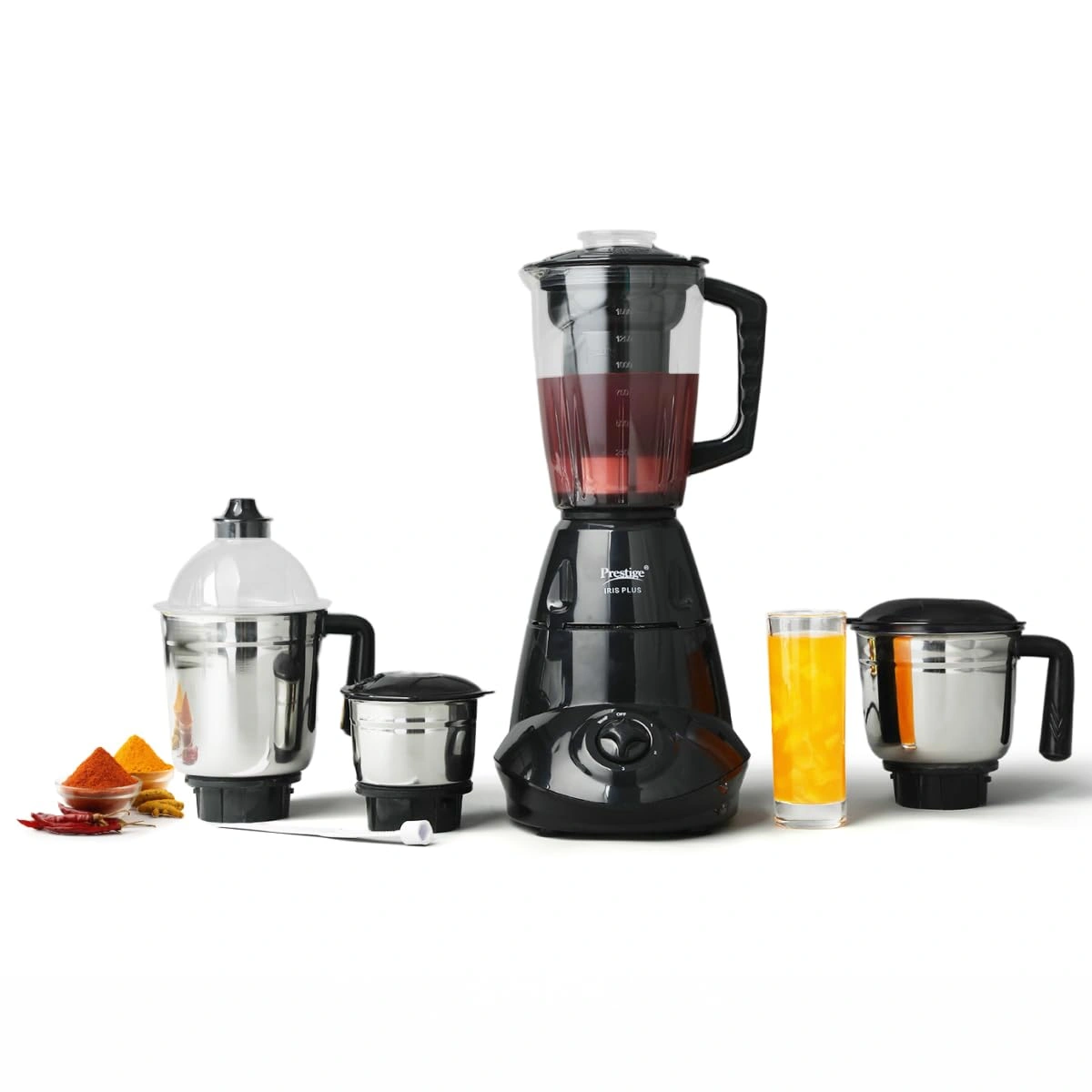
| Spec | Philips HL7756 | Prestige Iris 750W |
|---|---|---|
| Price | ₹3,814 | ₹3,249 |
| Wattage | 750W | 750W |
| Number of Jars | 3 | 4 (includes juicer jar) |
| Jar Sizes | 1.5L wet, 1L dry, 0.3L chutney | 1.5L wet, 1L dry, 1.5L juicer, 0.3L chutney |
| Jar Material | Stainless Steel | Stainless Steel + Polycarbonate (juicer) |
| Motor Type | Turbo Motor with Air Ventilation | Copper Motor |
| Continuous Grinding | 25 Minutes | Not specified |
| Speed Control | 3 Speed + Pulse | 3 Speed + Pulse |
| Blade Material | Stainless Steel | Stainless Steel |
| Overload Protection | Not specified | Yes (built-in) |
| ISI Certified | Not specified | Yes |
| Motor Warranty | 5 Years | 2 Years |
| Product Warranty | 2 Years | 2 Years |
| Amazon Rating | 4.0 ★ (36,056 reviews) | 3.8 ★ (74,493 reviews) |
Philips vs Prestige Mixer Grinder: Head-to-Head Comparison
1. Motor Power and Continuous Grinding
Both run at 750W — identical on paper. But what 750W delivers in daily Indian kitchen use depends significantly on motor thermal management rather than just wattage. The Philips HL7756 uses a Turbo Motor with advanced air ventilation — a design that actively channels airflow through the motor housing to dissipate heat during extended grinding sessions. This is what enables the explicitly stated 25-minute continuous grinding specification.
Twenty-five minutes of continuous grinding is a specification that matters enormously for Indian cooking. Idli and dosa batter grinding for a family of four takes 15 to 20 minutes of uninterrupted motor operation. Wet masala paste for a large batch of biryani or sambhar can take 10 to 15 minutes. A mixer grinder that overheats and cuts out mid-grind is not just inconvenient — it signals the motor is working beyond its thermal comfort zone, which shortens motor life significantly over years of daily heavy use.
The Prestige Iris uses a copper motor — copper windings are generally more thermally stable and efficient than aluminium-wound motors — and includes a built-in overload protector that automatically cuts power when the motor overheats, protecting it from damage. This is a genuine safety feature, but it also means the Prestige will stop mid-grind if pushed too hard for too long. The continuous grinding specification is not stated for the Prestige, which is a meaningful gap for households with heavy daily grinding requirements.
Philips edges ahead for heavy continuous grinding — the 25-minute specification directly addresses Indian kitchen conditions. Prestige's overload protector is a good motor safety feature but indicates a lower thermal threshold than the Philips Turbo Motor design.
2. Jars — 3 vs 4
The Prestige Iris includes 4 jars — 1.5L wet jar, 1L dry jar, 0.3L chutney jar, and a 1.5L juicer jar. The Philips HL7756 includes 3 jars — 1.5L wet jar, 1L dry jar, and 0.3L chutney jar. No juicer jar. This is the most immediately visible difference and the one most buyers notice first.
The juicer jar on the Prestige is made from transparent polycarbonate rather than stainless steel — designed for extracting juice from soft fruits and not suitable for dry grinding or heavy wet masala work. For households that make fresh juice regularly — mosambi, orange, watermelon — the Prestige's juicer jar is a genuine additional utility the Philips does not offer at any price. For households that do not juice regularly, the jar count difference becomes less relevant to the daily experience.
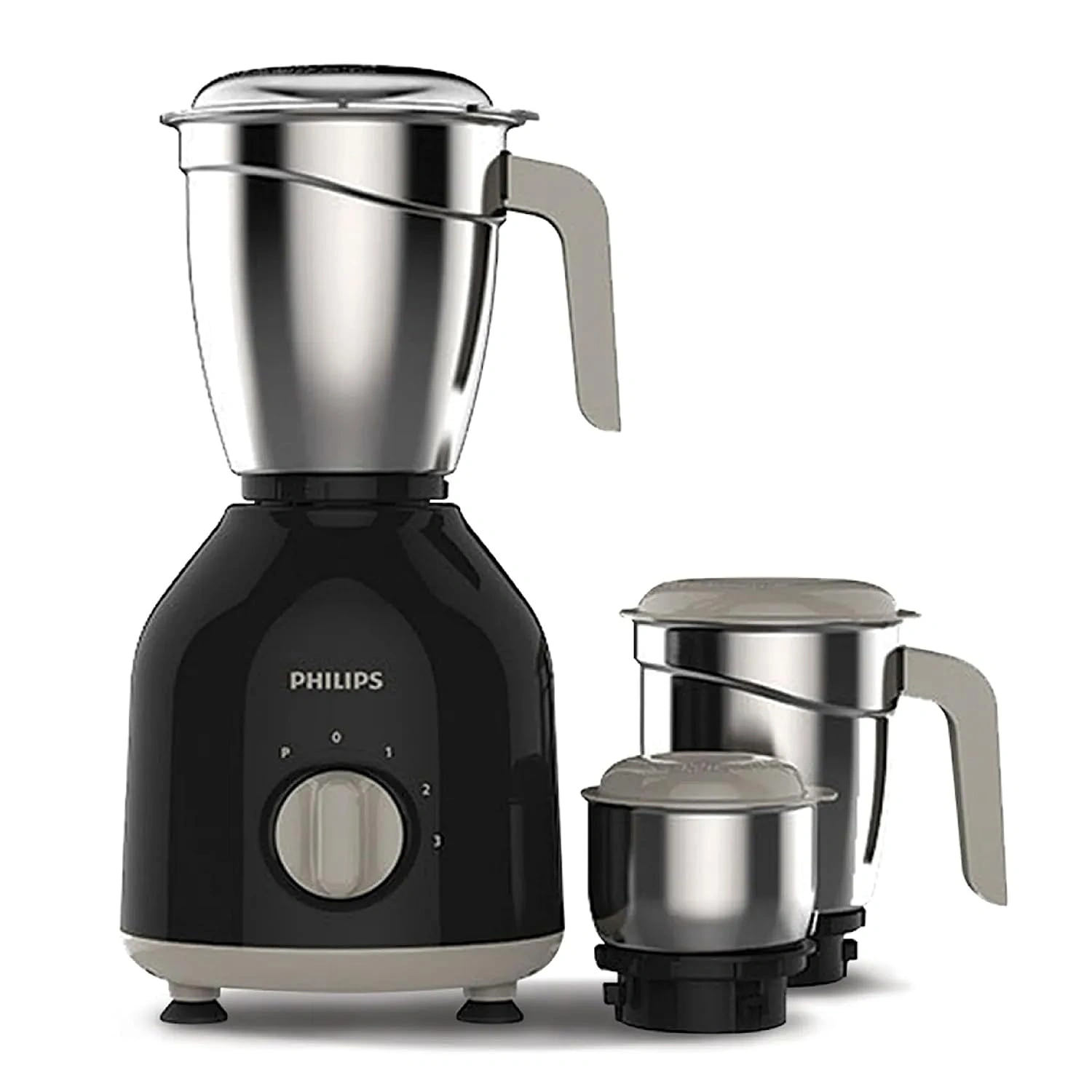
The Philips compensates with an Anti-Spill lid on the 1L dry jar that fastens without an external rubber gasket — preventing fine spice powder from escaping around the lid edge during grinding, which is a common frustration with standard dry jar lids. The semi-transparent lid on the wet and chutney jars lets you monitor grinding consistency without opening the jar mid-cycle. Both are practical design details that address real daily Indian kitchen frustrations.
Prestige wins on jar count — 4 jars including a juicer is genuine additional utility for households that juice regularly. Philips' Anti-Spill dry jar lid solves a real problem that standard lid designs do not address.
3. Blades and Grinding Performance
Both use stainless steel blades — the right standard for Indian mixer grinders given resistance to rust and corrosion from acidic ingredients common in Indian cooking like tamarind, tomatoes, and citrus. Philips describes specialised blades optimised for different grinding tasks across the three jars — wet jar blade for batter and masala, dry jar blade for spices and dry ingredients, chutney jar blade for the fine grinding chutneys require. This jar-specific blade design is standard practice across quality Indian mixer grinders and ensures the right blade geometry is applied to each type of grinding task.
Prestige describes their blades as sharp, rust-resistant stainless steel delivering fine uniform results across wet, dry, chutney, and juicing applications. The ISI certification on the Prestige validates blade sharpness and material quality against Bureau of Indian Standards specifications — an independent quality benchmark. In real-world grinding performance at 750W, both models deliver comparable results for everyday Indian kitchen tasks including idli batter, dal grinding, wet masala, and dry spice powder. The difference in grinding outcome between the two is minimal for standard use cases.
Comparable grinding performance for everyday Indian kitchen tasks. Prestige's ISI certification provides independent quality validation. Philips' jar-specific blade design is a more considered engineering approach to different grinding tasks.
4. Build Quality and Design
The Philips HL7756 uses an ABS plastic body with stainless steel jars — ABS is the standard body material for mixer grinders in this price range, offering reasonable durability and easy cleaning. At 3 kg it is lighter than the Prestige at 5.5 kg. The lighter weight makes it easier to move or store in a cabinet between uses, but also means slightly less stability on the counter during high-speed grinding of tough ingredients. Compact dimensions of 37D x 21W x 26H centimetres give it a small footprint suited to compact Indian kitchens where counter space is limited.
The Prestige Iris at 5.5 kg is significantly heavier — in a mixer grinder, heavier translates directly to better counter stability during high-speed grinding. A heavier base reduces the walking and vibration that lighter mixer grinders exhibit when running at full speed with a dense load like wet urad dal batter or thick coconut masala. The jar-locking system is specifically designed to reduce vibration during operation, contributing both to noise reduction and to overall unit stability. The sleek black body with smooth finish makes cleaning straightforward without textured surfaces trapping masala residue.
Prestige's heavier 5.5 kg build gives better counter stability during heavy grinding — a meaningful daily difference for households doing serious batter and masala work. Philips' lighter 3 kg body is more portable but less planted during full-load operation.
5. Warranty — Where Philips Wins Decisively
This is the single most important comparison on this page. The Philips HL7756 comes with a 5-year motor warranty and 2-year product warranty. The Prestige Iris comes with a 2-year warranty on both product and motor. The motor is the most expensive and most critical component in a mixer grinder — and in a household using the mixer grinder twice daily for Indian cooking, the motor is under significant sustained thermal and mechanical stress every single day.
Motor failures in mixer grinders typically begin appearing in years three to five of heavy use. Under the Philips' 5-year motor warranty, a motor failure in year four is covered at no cost — you call Philips, they fix or replace it, you pay nothing. Under the Prestige's 2-year motor warranty, the same failure in year four means a full motor replacement at your expense — typically ₹800 to ₹1,500 depending on the service centre and city.
The ₹565 price difference between the two models is eliminated by a single out-of-warranty motor service call on the Prestige. Over a five-year ownership period, the Philips' motor warranty coverage makes it the more financially rational choice for households using their mixer grinder intensively every single day. The maths is straightforward — pay ₹565 more upfront or risk paying ₹800 to ₹1,500 in year three or four.
Philips wins decisively on warranty — 5-year motor warranty vs Prestige's 2-year is the single most compelling reason to choose Philips for households with daily heavy grinding use. The ₹565 premium pays for itself with a single avoided out-of-warranty motor repair.
6. Price and Value
The Prestige Iris at ₹3,249 is ₹565 cheaper than the Philips HL7756 at ₹3,814 and comes with an extra juicer jar. On pure upfront cost the Prestige offers more for less. The 74,493 Amazon reviews at 3.8 stars versus Philips' 36,056 at 4.0 stars tells an interesting story — Prestige has sold more than twice as many units but has a lower satisfaction rating. Philips has fewer reviews but a higher satisfaction score, suggesting a more consistent ownership experience across a large and diverse buyer base.
The value equation shifts significantly when warranty is factored in. For light to moderate mixer grinder use — occasional weekend cooking, small household, not daily heavy grinding — the Prestige's extra jar and lower price make it the better upfront value. For a household running the mixer grinder hard twice daily — large family, daily batter grinding, heavy masala and chutney work — the Philips' 5-year motor warranty and 25-minute continuous grinding specification are worth the ₹565 premium and more over the full ownership period.
Prestige wins on upfront value — lower price and more jars. Philips wins on long-term value — 5-year motor warranty and proven continuous grinding capacity for the kind of heavy daily use that defines most Indian kitchens.
Who Should Buy Which Mixer Grinder?
Buy the Philips HL7756 if you: grind idli or dosa batter for a family of 4 or more regularly, run the mixer grinder for 15 to 20 minutes at a stretch without wanting it to cut out mid-grind, want a 5-year motor warranty that protects you from replacement costs in years three to five, and value a higher Amazon satisfaction rating across 36,000 verified buyers. The ₹565 premium over the Prestige is insurance — pay it once upfront or pay more later in repair costs.
Buy the Prestige Iris 750W if you: want a juicer jar for fresh mosambi or orange juice alongside your grinding needs, use the mixer grinder for moderate daily tasks rather than extended continuous grinding, want the lower ₹3,249 price point, or prefer an ISI-certified product from the most trusted Indian kitchen appliance brand with one of the widest service networks in the country.
What to Look for in a Mixer Grinder for Indian Kitchen
Wattage matched to grinding intensity. 500W is adequate for light occasional use — chutneys, small spice grinding, occasional smoothies. 750W is the right standard for daily Indian cooking — wet masala, idli dosa batter, dal grinding. 1000W and above suits commercial-scale grinding or households cooking for 8 or more people daily. Both the Philips and Prestige at 750W are correctly spec'd for the majority of Indian household cooking needs.
Continuous grinding capacity is more important than wattage alone. A 750W motor that overheats after 10 minutes is less useful than a 750W motor rated for 25 minutes of continuous operation. Always check whether the manufacturer specifies a continuous grinding duration — Philips does (25 minutes), Prestige does not. If continuous grinding duration is not stated, assume the motor needs a rest break every 5 to 10 minutes under heavy load.
Motor warranty is the most meaningful long-term specification. The motor is the most expensive component and the most likely to need replacement in years three to five of daily heavy use. A 5-year motor warranty vs a 2-year warranty is not a minor difference — it is the difference between a covered repair and an out-of-pocket expense of ₹800 to ₹1,500. Always check motor warranty separately from product warranty — they are often different durations.
Jar count and size should match your actual cooking habits. Three jars covering wet, dry, and chutney grinding is adequate for most Indian households. A fourth juicer jar adds genuine utility if you make fresh juice regularly — but adds no value if the juicer sits unused in a cabinet. Match jar count to what you will actually use rather than buying the higher jar count as a default.
ISI certification matters for safety. ISI certification from the Bureau of Indian Standards validates that the appliance meets Indian safety and quality standards including electrical safety, motor performance, and blade durability. The Prestige Iris carries ISI certification. The Philips HL7756 does not explicitly state ISI certification, though Philips products sold in India through authorised channels meet applicable Indian safety standards through their own quality process.
Service network availability in your city. A mixer grinder requiring service in a tier-2 or tier-3 city needs a brand whose service centre is actually reachable within a reasonable distance and time. Prestige has one of the widest kitchen appliance service networks in India. Philips has strong coverage in metros and large cities. Check the nearest authorised service centre for whichever brand you choose before buying — particularly if you are outside a major metro.
So Which Mixer Grinder Should You Finally Buy?
You use your mixer grinder daily for heavy Indian cooking — idli dosa batter for a family of 4 or more, wet masala paste, extended grinding sessions that run 15 to 20 minutes at a stretch. The 25-minute continuous grinding specification and 5-year motor warranty make it the more durable long-term investment. At ₹3,814 with 36,056 Amazon reviews at 4.0 stars, it is one of the most validated mixer grinders in India. The ₹565 premium over the Prestige pays for itself with a single avoided motor replacement in year three or four.
You want more jars including a juicer jar for fresh juice, your mixer grinder use is moderate rather than heavy continuous daily grinding, you want ISI certification from India's most trusted kitchen appliance brand, your budget stops at ₹3,249, or you are in a city where Prestige's wider service network gives you more accessible after-sales support than Philips. At ₹3,249 with 74,493 reviews, it is the most purchased mixer grinder in India right now for good reason.
For most Indian households cooking three meals a day with significant grinding requirements, the Philips HL7756 is the better long-term buy — the 5-year motor warranty alone justifies the modest ₹565 premium. For lighter users or households where the juicer jar is a genuine daily utility, the Prestige Iris delivers strong value at a lower price from a brand that has been in Indian kitchens for over seventy years.
 ₹3,814
Frequently Asked Questions(FAQs)
Which brand is best for mixer grinders in India?
For heavy daily Indian kitchen use, Philips and Preethi consistently rank as the top two mixer grinder brands — both for motor quality, continuous grinding performance, and after-sales service. Philips leads on motor warranty with 5 years on the HL7756. Prestige is the highest-selling brand by volume with the widest service network and strong ISI-certified build quality at competitive prices. For most Indian households, either brand at the 750W tier delivers reliable performance — the choice comes down to whether motor warranty length or jar count and price matter more to your specific situation.
Is Philips a good brand for mixer grinders?
Yes — Philips is one of the most trusted mixer grinder brands in India. The HL7756 has 36,056 Amazon reviews at 4.0 stars with over 3,000 units sold every month, reflecting sustained real-world buyer satisfaction across varied Indian kitchen conditions. The 5-year motor warranty, 25-minute continuous grinding specification, and Turbo Motor with advanced air ventilation make Philips mixer grinders particularly well suited to heavy daily Indian cooking — idli dosa batter, wet masala, extended grinding sessions. Philips is Asia's most trusted home appliances brand according to independent research.
Is Philips better than Havells mixer grinder?
Philips and Havells compete closely in the 750W mixer grinder segment. Philips has the stronger motor warranty at 5 years on the HL7756 — Havells typically offers 2 to 3 years. Philips also has a larger Amazon review base providing more real-world validation. Havells counters with strong build quality, stainless steel body options on some models, and a reliable India service network. For continuous heavy grinding like daily batter, Philips' thermal management and warranty terms give it the edge. For buyers who prioritise build premium and a domestic brand at similar price points, Havells is a strong alternative worth considering.
Which Indian mixer grinder is the best?
For heavy daily Indian cooking, the Philips HL7756 at ₹3,814 is the best mixer grinder at this price point — the 5-year motor warranty, 25-minute continuous grinding, and 4.0 stars across 36,000+ reviews make it the most validated choice for intensive daily use. For value-focused buyers who want more jars including a juicer at a lower price, the Prestige Iris 750W at ₹3,249 is the most purchased mixer grinder in India and backed by Prestige's extensive service network. Both are strong — the best choice depends on whether long-term motor warranty protection or jar count and price is the priority for your kitchen.
Which is better — Bajaj or Philips mixer grinder?
Bajaj mixer grinders are typically priced lower than Philips at the same wattage — making them attractive for budget-conscious buyers. However, Bajaj's motor warranty terms are generally shorter than Philips' 5-year motor warranty, and their continuous grinding specifications are not as clearly documented. Philips at ₹3,814 for the HL7756 offers better long-term motor protection and more thoroughly documented performance specs than comparable Bajaj models at similar prices. For the lowest possible upfront cost, Bajaj is a viable option. For longevity and warranty coverage for daily heavy use, Philips is the stronger choice.
How long do mixer grinders last in India?
A good quality 750W mixer grinder used twice daily for standard Indian cooking should last 5 to 8 years with proper care. The motor is the component most likely to need attention first — which is why a 5-year motor warranty like the one on the Philips HL7756 is meaningful real-world protection. Key factors that extend mixer grinder life include allowing the motor to cool between extended grinding sessions, not overloading the jar beyond its rated capacity, cleaning jars promptly after use to prevent residue build-up on the blade coupling, and running the machine at lower speeds for softer ingredients rather than always using maximum speed.
Also Read: Best Chimney for Kitchen Under 10000 in India 2026 | Best Air Fryers Under 5000 in India 2026 | Philips Air Fryer vs Milton Rapid 5L