
Prestige vs Pigeon Induction Cooktop: Which One Should You Buy in 2026?
The Pigeon Cruise at ₹1,999 is the #1 bestselling induction cooktop in India and delivers 1800W for basic everyday cooking at a price that is hard to argue with. The Prestige PIC 20 at ₹2,950 costs ₹951 more but brings 4KV surge protection, Automatic Voltage Regulation, 8 Indian preset menus including Dosa, Idli, and Pressure Cook, and intelligent power sensing that adjusts wattage to the vessel size. If you cook a variety of Indian dishes daily and live in an area with voltage fluctuations, the Prestige is worth every rupee of the premium. If you want a basic induction cooktop for boiling, heating, and simple cooking at the lowest possible price, the Pigeon does the job.
- Why Every Indian Kitchen Needs an Induction Cooktop as a Backup
- Prestige vs Pigeon Induction Cooktop: What Makes Them Different?
- Prestige PIC 20 vs Pigeon Cruise: At a Glance
- Prestige vs Pigeon Induction Cooktop: Head-to-Head Comparison
- Who Should Buy Which Induction?
- What to Look for in an Induction Cooktop in India
- So Which One Should You Finally Buy?
- Frequently Asked Questions
Why Every Indian Kitchen Needs an Induction Cooktop as a Backup
The gas cylinder runs out on a Sunday evening when every dealer is closed. The main burner is occupied with a pressure cooker that cannot be moved for the next twenty minutes and you need to make chai simultaneously. Someone in the house is on a diet and wants their food cooked separately with precise heat control that a gas flame on full blast cannot provide. These are the three scenarios that have driven induction cooktop sales in India to the point where they are no longer a luxury purchase — they are practical kitchen infrastructure for the 2026 Indian household.
The deeper reason induction cooktops have gone mainstream is electricity. As India's power infrastructure has improved across tier-2 and tier-3 cities, the economics of induction cooking have shifted. A 1600 to 1800 watt induction cooktop converts nearly 90% of its energy into heat in the vessel — gas stoves convert roughly 40% of their energy into useful cooking heat, with the rest lost to the surrounding air. For households running the cooktop daily, the efficiency advantage compounds meaningfully on the monthly electricity bill against the rising price of LPG cylinders.
At under ₹3,000, both the Prestige PIC 20 and Pigeon Cruise represent the Indian induction cooktop market at its most competitive — two of the most purchased models in the country, from two of the most trusted kitchen appliance brands, separated by less than ₹1,000. Understanding what that ₹951 difference actually buys you is the entire point of this comparison.
Prestige vs Pigeon Induction Cooktop: What Makes Them Different?
Prestige is one of India's oldest kitchen appliance brands — established in 1955, it has been a fixture in Indian kitchens for nearly seven decades. The brand is owned by TTK Prestige Limited and manufactures pressure cookers, cookware, gas stoves, and small appliances with a consistent focus on the Indian cooking context. When Prestige designs an induction cooktop, the 8 preset menus — Pressure Cook, Curry, Dosa, Chapati, Idli, Deep Fry, Heat Milk, Keep Warm — are not marketing additions. They are the result of decades of understanding exactly what Indian households actually cook on a daily basis and calibrating temperature and time profiles for each. The 4KV surge protection and Automatic Voltage Regulator on the PIC 20 reflect the same India-first engineering — these are features that matter specifically in the Indian power supply context, not generic specifications borrowed from international models.
Pigeon is owned by Stovekraft Limited and has built its market position almost entirely on value — delivering functional kitchen appliances at the lowest viable price point without cutting corners on the core function. The Cruise is the #1 bestselling induction cooktop on Amazon India with over 75,000 reviews and 7,000+ purchases every month — numbers that reflect a product that genuinely works at a price that removes all hesitation from the buying decision. Pigeon's philosophy is not to compete on premium features but to make the entry point to induction cooking as low as possible, and the Cruise executes that philosophy as well as any product in the Indian small appliance market.
The choice between them is fundamentally about what you expect an induction cooktop to do. If you want a reliable heating element for boiling water, making chai, and basic cooking at the lowest possible price, Pigeon has no peer at ₹1,999. If you want a cooktop that understands Indian cooking — that knows a Dosa requires sustained medium-low heat different from Deep Fry which requires rapid high heat, and that protects itself and your home from the voltage spikes that are an everyday reality across India — Prestige is the more complete appliance.
Prestige PIC 20 vs Pigeon Cruise Induction: At a Glance
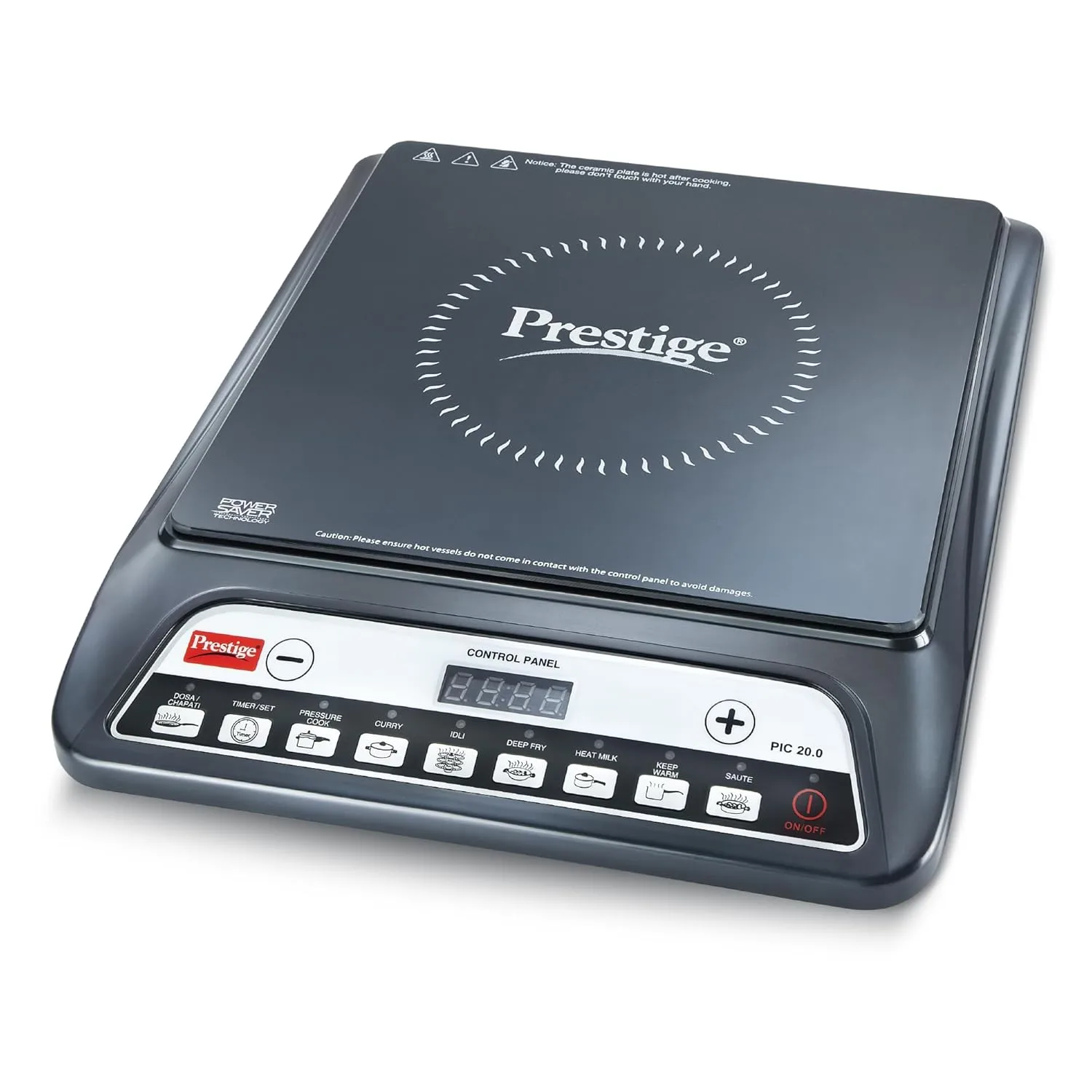 ₹2,950
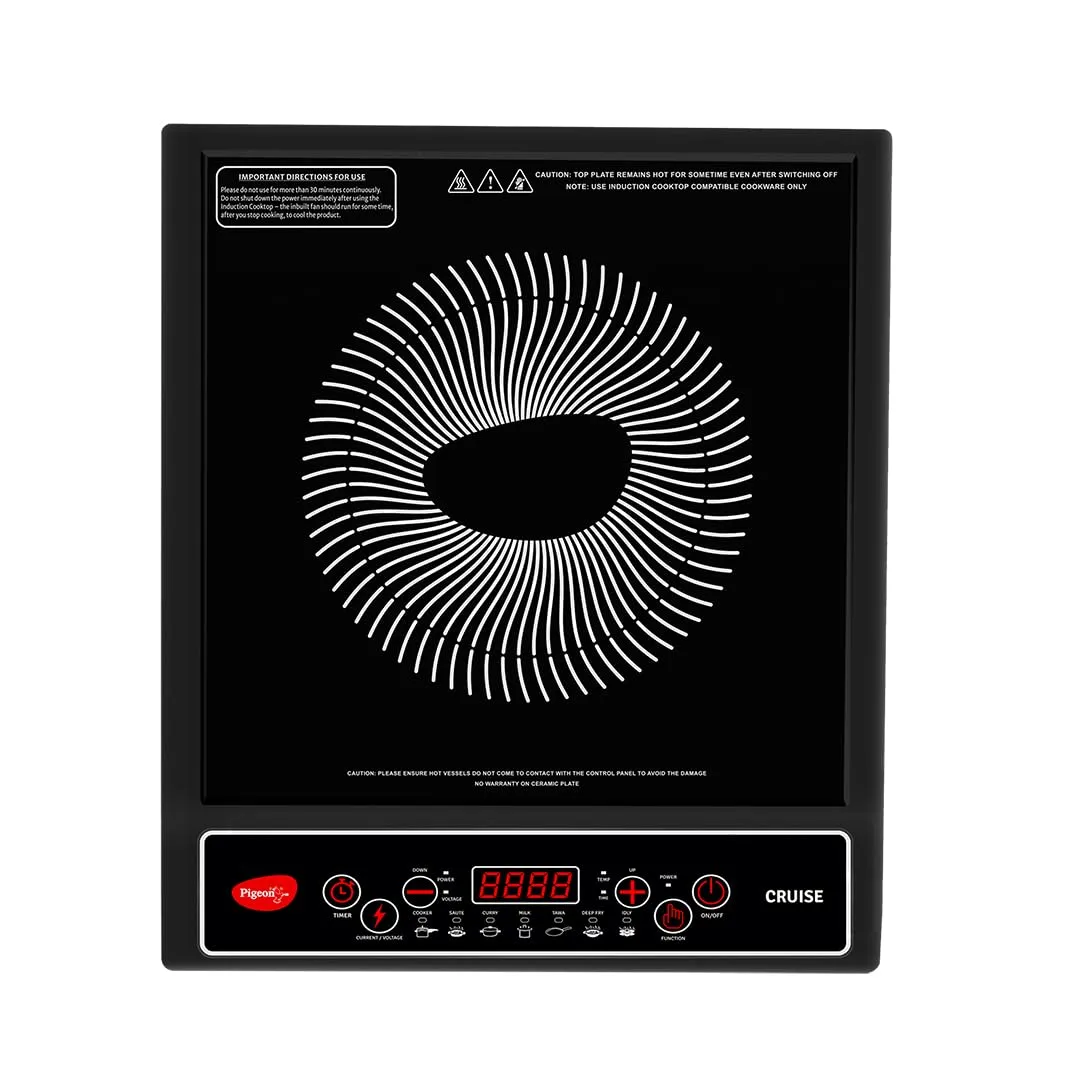 ₹1,999
| Spec | Prestige PIC 20 | Pigeon Cruise |
|---|---|---|
| Price | ₹2,950 | ₹1,999 |
| Wattage | 1600W | 1800W |
| Voltage | 230V | 220V |
| Preset Menus | 8 (Indian-specific) | Not specified |
| Surge Protection | 4KV | Short Circuit Protection |
| Voltage Regulation | Yes (AVR) | No |
| Power Sensing | Yes (adjusts to vessel size) | No |
| Controls | Soft Touch Button | Soft Push Button |
| Display | LED | 7-Segment LED |
| Timer | Yes | Yes (Auto Switch Off) |
| Auto Switch Off | Yes | Yes |
| Top Surface | Crystal Glass | Crystal Glass |
| Cord Length | Not specified | 1.3 metres |
| Warranty | 1 Year | 1 Year |
| Amazon Rating | 4.0 ★ (43,924 reviews) | 3.7 ★ (75,621 reviews) |
Prestige vs Pigeon Induction Cooktop: Head-to-Head Comparison
1. Wattage and Heating Performance
The Pigeon Cruise runs at 1800W — 200W more than the Prestige PIC 20's 1600W. On paper this means the Pigeon heats faster, boils water sooner, and reaches high temperatures more quickly. For buyers who want maximum raw heating power for the money, the Pigeon wins this number. In real-world kitchen use, the difference between 1600W and 1800W is roughly 30 to 45 seconds on a full pot of water — noticeable in a side-by-side test, largely irrelevant during actual cooking where the bottleneck is never how fast the water initially heats.
The more meaningful heating difference is in how each cooktop manages power once the cooking temperature is reached. The Prestige PIC 20 uses sensor-based intelligent power control that continuously modulates wattage in real time to maintain target temperature — rather than cycling between full power and zero power the way simpler induction cooktops work. This prevents the overshooting and temperature dipping that causes milk to boil over suddenly or dal to stick at the bottom despite being on a low setting. It also uses vessel-sensing technology that detects the size of the vessel placed on the glass and adjusts the power output accordingly — a large pressure cooker gets full power, a small milk pan gets appropriately reduced power without manual adjustment.
The Pigeon Cruise does not specify intelligent power modulation — it operates at its set power level without sensor-based adjustment. For simple high-heat cooking tasks this is entirely adequate. For precise temperature-dependent cooking like making dosas at consistent medium-low heat or pressure cooking that needs sustained pressure without overshooting, the Prestige's power intelligence is a daily practical advantage.
Pigeon wins on raw wattage at 1800W vs 1600W. Prestige wins on intelligent power management — sensor-based temperature modulation and vessel-size detection make it the more capable cooktop for varied Indian cooking beyond basic boiling and frying.
2. Preset Menus and Indian Cooking
This is where the Prestige PIC 20 justifies most of its premium over the Pigeon Cruise, and it is worth understanding what Indian preset menus on an induction cooktop actually do versus what they sound like they do. Each preset is not simply a named button that runs the cooktop at a fixed temperature — it runs a pre-programmed combination of temperature range, power modulation pattern, and timing that is calibrated for the specific thermal behaviour of that dish. Pressure Cook runs sustained high heat to build and maintain pressure. Dosa runs medium-low sustained heat with slight variations to replicate the behaviour of a cast iron tawa being used on a gas flame. Idli runs a gentle steaming-level heat. Keep Warm runs at the minimum temperature needed to hold food without cooking it further. Deep Fry runs at the sustained high temperature needed for oil to stay at frying temperature as food is added and lowers it momentarily.
For a household that cooks all of these dishes regularly — which describes the majority of Indian families — having calibrated presets means consistently better results with less monitoring. You do not need to stand over the cooktop adjusting heat levels while simultaneously managing other parts of the meal. The preset does the management for you. This is the same reason Indian menu presets are a premium feature on microwave ovens — the convenience of calibrated automation for dishes you cook five times a week compounds into meaningful time and effort savings.
The Pigeon Cruise does not specify preset Indian menus. It offers manual temperature and power control — which works perfectly well for experienced cooks who know their temperature settings by habit. For households where multiple family members use the cooktop with varying cooking experience, the Prestige's presets mean anyone in the house can cook a consistent dosa or pressure cook dal without needing to know what temperature setting to use.
Prestige wins decisively on Indian cooking intelligence — 8 calibrated preset menus covering the full range of daily Indian cooking versus Pigeon's manual-only control. For households cooking varied Indian meals daily, this is the most practically impactful difference between the two cooktops.
3. Voltage Protection and Safety
The Prestige PIC 20's 4KV surge protection is the specification that matters most to Indian buyers in cities and towns where voltage stability is not guaranteed. A 4KV rating means the cooktop's internal electronics are protected against voltage spikes of up to 4,000 volts — the kind that occur during lightning strikes near the power grid, during sudden load shedding restoration, or during the voltage fluctuations that are an everyday occurrence across large parts of India outside metro areas. Without surge protection, a single significant voltage spike can permanently damage the induction coil or the control circuitry, turning a ₹3,000 appliance into scrap without any warning.
The Automatic Voltage Regulator on the Prestige handles the more common problem of sustained low or high voltage — not spikes but steady fluctuation. Indian household voltage commonly drops to 180-200V during peak demand periods and rises above 240V at low-demand times. AVR cushions these variations and maintains stable power delivery to the cooktop's electronics, extending the lifespan of the appliance in real Indian grid conditions. This is not theoretical protection — it is why Prestige appliances consistently show longer lifespans in buyer reviews from tier-2 and tier-3 cities where grid quality is most variable.
The Pigeon Cruise specifies short circuit protection — protection against the appliance's own internal wiring failure — but does not specify external surge protection or voltage regulation. For buyers in cities with stable power supply, this difference matters less. For buyers in areas with frequent voltage fluctuations, power cuts, or monsoon-season electrical instability, the Prestige's protection specifications are a meaningful long-term durability advantage that partially justifies the price premium on their own.
Prestige wins significantly on electrical protection — 4KV surge protection and Automatic Voltage Regulation versus Pigeon's basic short circuit protection only. For buyers in areas with unstable power supply, this difference alone justifies a significant portion of the ₹951 premium.
4. Controls and Display
Both cooktops use soft-touch button controls on a crystal glass surface — no mechanical switches or knobs that collect grease and become difficult to clean after months of kitchen use. The glass surface wipes clean with a damp cloth in seconds, which is a meaningful daily quality of life advantage over older mechanical-control induction cooktops and gas stoves with grates and burner caps that require periodic deep cleaning.
The Pigeon Cruise's 7-segment LED display shows power level and temperature settings clearly — functional and easy to read from standing height. The Prestige PIC 20 also uses an LED display alongside its preset menu buttons. The Prestige's control layout needs to accommodate 8 preset options plus manual temperature and timer control, which makes its panel slightly more involved than the Pigeon's simpler interface. For buyers who want simplicity — press one button, adjust one dial — the Pigeon's interface is more straightforward. For buyers who want to use presets regularly, the additional buttons become second nature within a week of daily use.
Both cooktops include a timer with auto switch-off — the cooktop cuts power when the timer expires, which prevents food from burning if you are away from the kitchen and eliminates the energy waste of a cooktop left on inadvertently. Both also include the standard induction safety feature of activating only when an induction-compatible vessel is detected on the surface — the cooktop will not heat without a vessel, eliminating the burn risk of an accidentally activated element.
Pigeon wins on interface simplicity — straightforward controls with a clear 7-segment display and no unused preset buttons cluttering the panel. Prestige's interface is slightly more complex but becomes intuitive once you are using the presets regularly. Both have the same core safety features.
5. Price and Value
The ₹951 gap between ₹1,999 and ₹2,950 is not large in absolute terms — it is roughly the price of a restaurant meal for two — but it represents a 47% premium for the Prestige over the Pigeon. At that premium, the question is not whether Prestige is better in a vacuum — it clearly is, on specifications. The question is whether those better specifications translate into better daily cooking outcomes for your specific household.
For a household that uses the induction cooktop primarily as a backup — gas cylinder emergencies, making chai when the main burner is occupied, the occasional weekend breakfast — the Pigeon Cruise at ₹1,999 is the obvious choice. The raw 1800W heating power does the job, the auto switch-off and vessel detection cover the essential safety bases, and ₹1,999 is an amount that requires zero deliberation for a functional kitchen appliance. The #1 bestseller status and 75,000 reviews confirm that this exact value proposition resonates with Indian buyers at scale.
For a household that uses the induction cooktop as a primary or near-primary cooking surface — daily dal, rice, curries, dosas, pressure cooking — the Prestige PIC 20's ₹951 premium buys 4KV surge protection that could save the appliance from a single voltage spike, intelligent power modulation that improves cooking results across the full range of Indian dishes, and 8 preset menus that make the cooktop genuinely easier for every person in the household to use. Over a two to three year lifespan of daily use, ₹951 works out to roughly ₹1.30 extra per day — a number that is easy to justify against the practical improvements the Prestige delivers.
Pigeon wins on upfront value — ₹1,999 for a functional 1800W induction cooktop is exceptional. Prestige wins for daily primary-use households — surge protection, intelligent power control, and Indian presets justify the ₹951 premium for cooks who use the cooktop seriously and regularly.
Who Should Buy Which Induction Cooktop?
Buy the Prestige PIC 20 if you: use the induction cooktop as a primary or near-primary cooking surface for daily Indian cooking. Cook a variety of dishes — dal, curry, dosa, idli, pressure cooking — and want calibrated presets that remove the guesswork from temperature settings. Live in an area with voltage fluctuations, frequent power cuts, or monsoon-season electrical instability where 4KV surge protection and AVR are meaningful long-term durability investments. Want intelligent power modulation that prevents milk boiling over and dal sticking even on low settings. Have multiple family members with varying cooking experience who benefit from one-touch Indian menu presets.
Buy the Pigeon Cruise if you: want a backup induction cooktop for gas cylinder emergencies and occasional use at the lowest possible price. Use the cooktop primarily for simple tasks — boiling water, making chai, heating food — where 1800W raw power and basic temperature control are all you need. Live in an area with stable power supply where surge protection matters less. Want the most purchased induction cooktop in India with the largest buyer community and lowest barrier to entry. Are buying your first induction cooktop and want to try the category before investing more.
What to Look for in an Induction Cooktop in India
Wattage determines heat speed, not cooking quality. Higher wattage means faster initial heating and boiling. 1600W to 1800W is the standard range for Indian household cooktops and is sufficient for all daily cooking tasks including pressure cooking and deep frying. Above 2000W is available on larger models but requires a dedicated circuit in many older Indian homes. Below 1400W is insufficient for efficient pressure cooking. Both the Prestige and Pigeon fall within the ideal range for Indian household use.
Indian preset menus are more useful than they appear on a spec sheet. Every Indian kitchen cooks the same core set of dishes repeatedly — dal, rice, curry, chai, dosas. Presets calibrated for these dishes deliver better results with less monitoring than manual temperature control, particularly for cooks who are new to induction cooking and have not yet learned the temperature equivalents of their gas flame intuition. If you cook a variety of Indian dishes daily, presets pay for themselves in reduced attention and better consistency within a month of use.
Surge protection matters more in India than anywhere else. Indian household voltage is nominally 220-230V but fluctuates significantly in practice, particularly in smaller cities, rural areas, and during monsoon season. A cooktop without surge protection is vulnerable to voltage spike damage that voids the warranty and requires full replacement. If you live in an area with any history of voltage instability, surge protection is not optional — it is cheap insurance on a daily-use appliance.
Induction cookware compatibility is the hidden cost most buyers forget. Induction cooktops only work with cookware that has a magnetic base — cast iron, magnetic stainless steel, and most modern hard-anodised aluminium with induction bases. Standard aluminium pressure cookers, copper-bottom vessels, and old stainless steel cookware without magnetic bases will not work. Before buying an induction cooktop, check your existing cookware with a magnet — if the magnet sticks to the base, the vessel is induction compatible. Budget ₹500 to ₹1,500 for a basic induction-compatible pressure cooker if your existing one is not compatible.
Crystal glass surface is standard at this price — handle it accordingly. Both cooktops use a crystal glass top plate that is smooth, easy to clean, and highly durable under normal use. It will crack if a heavy vessel is dropped on it from height or if cold water is poured on a hot surface. Standard precautions apply — do not slide heavy cast iron across it, let it cool before cleaning, and do not use abrasive pads on the surface. Under normal cooking conditions, crystal glass induction tops last the full warranty period and well beyond without issues.
So Which One Should You Finally Buy?
You use the induction cooktop daily for varied Indian cooking and want 8 calibrated Indian preset menus, intelligent power modulation that adjusts to vessel size and prevents overcooking, and 4KV surge protection with AVR that protects the appliance against Indian voltage realities. At ₹2,950 it is the more complete induction cooktop — better engineered for the Indian kitchen context and built to last longer in Indian power supply conditions.
You want a backup induction cooktop or a first induction cooktop at the lowest possible price. 1800W, auto switch-off, vessel detection, and a 7-segment display cover everything a basic induction cooktop needs to do at ₹1,999. The #1 bestseller status with 75,000 reviews confirms it works — and at this price, there is no reason to deliberate.
For most Indian households using an induction cooktop as a serious daily cooking surface, the Prestige PIC 20 is the better investment at ₹2,950 — the surge protection alone is worth paying for in most of India, and the Indian preset menus and intelligent power management make it a meaningfully better cooking appliance. For buyers who want the lowest possible entry price to induction cooking with no intention of using it as a primary cooktop, the Pigeon Cruise at ₹1,999 is exactly what it claims to be — India's most purchased induction cooktop for a reason.
₹2,950
₹1,999
FAQ
Which induction cooktop is best in India under ₹3,000?
The Prestige PIC 20 at ₹2,950 is the best-specified induction cooktop under ₹3,000 in India — 4KV surge protection, AVR, 8 Indian preset menus, and intelligent power management make it the most complete option for daily Indian cooking. If your budget is closer to ₹2,000, the Pigeon Cruise at ₹1,999 is the #1 bestseller in the category and delivers reliable 1800W performance without frills. Both carry 1-year warranties and use crystal glass surfaces with auto switch-off safety.
Can I use a pressure cooker on an induction cooktop?
Yes — but only if the pressure cooker has a magnetic base. Most modern induction-compatible pressure cookers are made from magnetic stainless steel and are specifically labelled as induction-compatible. Standard aluminium pressure cookers — which are the most common type in Indian kitchens — are not induction compatible. Test your existing pressure cooker by holding a magnet to the base: if it sticks firmly, it is induction compatible. If it does not stick, you will need to buy an induction-compatible pressure cooker before using these cooktops for dal or rice. Budget ₹600 to ₹1,200 for a basic induction-compatible model.
Is induction cooking safe for Indian kitchens?
Yes — induction cooking is significantly safer than gas cooking for Indian kitchens. There is no open flame, no gas leak risk, and no combustion. The cooktop surface only heats where an induction-compatible vessel is placed — the rest of the glass surface stays cool to the touch even while cooking, dramatically reducing accidental burn risk particularly in households with children. The vessel detection feature means the cooktop will not activate without a compatible vessel on the surface, eliminating the risk of an accidentally switched-on element burning a hand. Both the Prestige PIC 20 and Pigeon Cruise include auto switch-off that cuts power when the timer expires or the vessel is removed.
Does an induction cooktop consume more electricity than a gas stove?
No — induction cooktops are significantly more energy efficient than gas stoves. A gas stove converts roughly 40% of its energy into useful cooking heat, with the rest lost to the surrounding air and kitchen environment. An induction cooktop converts approximately 85 to 90% of its electrical energy directly into heat in the vessel. In practice this means an induction cooktop cooks the same meal using significantly less energy than gas. The efficiency advantage becomes more meaningful as LPG cylinder prices rise — many households that switched from gas to induction as a primary cooktop in the last three years report lower total monthly cooking energy costs even after accounting for electricity tariffs.
What is the difference between 1600W and 1800W induction cooktop?
The practical difference is heating speed — an 1800W cooktop will boil a litre of water approximately 30 to 45 seconds faster than a 1600W cooktop. In real cooking conditions, this difference is minor and rarely the deciding factor in a purchase decision. What matters more for cooking quality is how the cooktop manages power once the target temperature is reached — whether it maintains consistent heat through intelligent modulation or simply cycles between full power and zero power. The Prestige PIC 20 at 1600W with intelligent power management delivers better cooking results for temperature-sensitive Indian dishes than a basic 1800W cooktop that lacks comparable power control.
How long do induction cooktops last?
A well-maintained induction cooktop from a quality brand typically lasts 5 to 8 years with daily use. The main failure modes are the induction coil wearing out after extended high-power use, the control electronics failing due to voltage spikes or heat damage, and the glass surface cracking from impact or thermal shock. Surge protection as on the Prestige PIC 20 directly addresses the most common electronics failure mode in the Indian context. To extend lifespan: do not pour cold water on a hot surface, do not slide heavy cast iron pots across the glass, run the cooktop in a ventilated area so the cooling fan is not obstructed, and wipe the surface clean after each use to prevent grease buildup around the edges.
Which brand is better for induction cooktop — Prestige or Pigeon?
Prestige is the better brand on specifications, engineering depth, and India-specific features — 68 years of Indian kitchen appliance experience shows in the PIC 20's surge protection, AVR, and calibrated Indian preset menus. Pigeon is the better brand on value — the Cruise is the most purchased induction cooktop in India precisely because it delivers reliable core performance at the lowest viable price. The right brand depends on your use case: Prestige for serious daily Indian cooking, Pigeon for a functional and affordable entry point to induction cooking.
Also Read: Best Air Fryers Under 5000 in India 2026 | Best Water Purifiers Under 10000 in India 2026 | Philips vs Prestige Mixer Grinder 750W